The two most effective approaches for soothing the liver: 1. Gui Shao Di Huang Tang (Rehmannia Six Combination with Peony) 2. Yi Guan Jian (Nourishing Liver and Kidney Decoction)
When we talk about "肝郁" (liver qi stagnation), most people's first thought is to use liver-soothing and qi-regulating herbs like bupleurum and cyperus. That's not wrong, but clinical TCM practice has found that simply "draining the liver" to forcibly regulate qi movement sometimes yields unsatisfactory results—it might even worsen the problem. For example, patients may feel more irritable and prone to anger, or experience more pronounced distending pain in the chest and hypochondrium. Why is this?
Traditional Chinese medicine believes that "the liver's substance is yin while its function is yang." The liver's normal dispersing function ("function of yang") requires sufficient liver blood and kidney essence ("substance of yin") as material foundations for nourishment and softening. If liver blood is insufficient or kidney essence is deficient, and the liver substance lacks nourishment, it is like a tree withering from water deficiency—its branches (liver qi) naturally become stiff and twisted (stagnation). In such cases, forcibly using excessive dispersing herbs to "straighten" these branches may instead consume the already deficient blood and yin, leading to "increasing dryness with further dispersion, and increasing deficiency with further dispersion."
Therefore, for liver stagnation caused by liver and kidney deficiency, a safer and more effective approach to soothe the liver is to nourish liver blood and replenish kidney essence. When liver blood and kidney essence are sufficient, the liver body is nourished, and liver qi will naturally regain its free flow and comfort. The two formulas, Gui Shao Dihuang Tang and Yiguan Jian, precisely embody this core concept of "nourishing to soothe the liver."
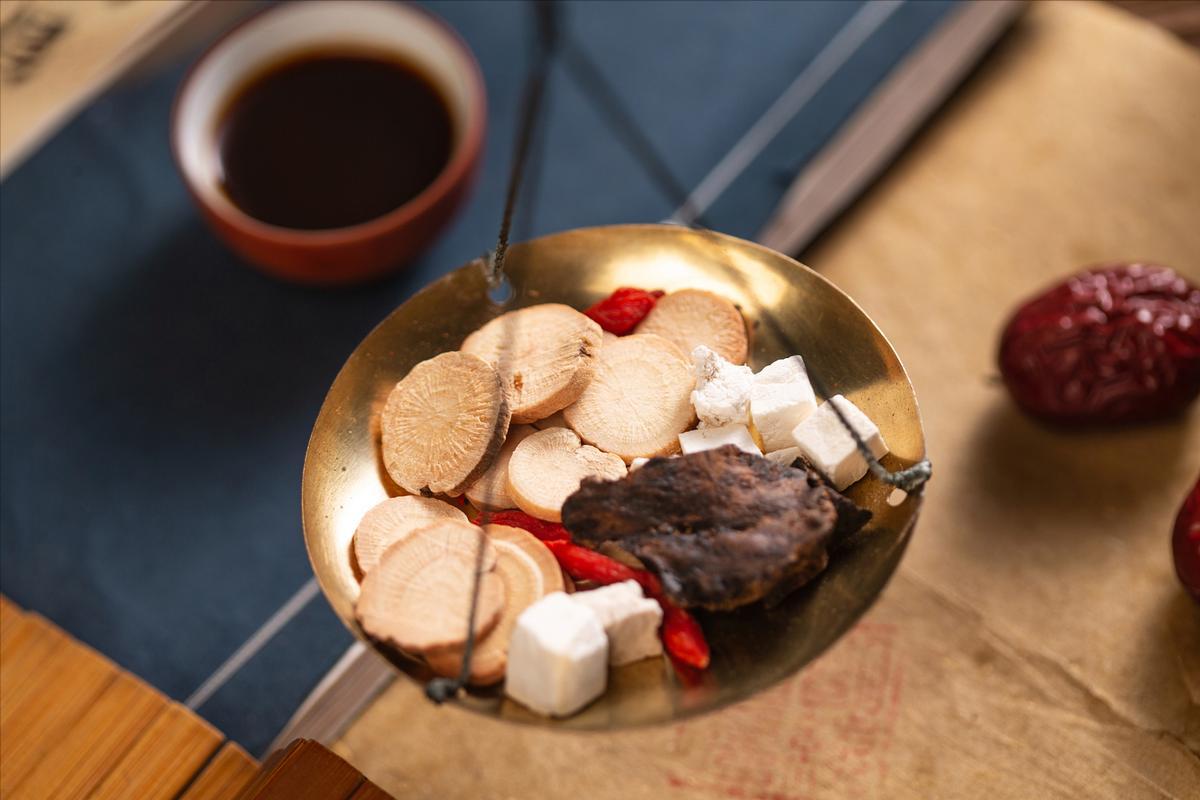
1. Gui Shao Dihuang Tang: Simultaneously tonifies the liver and kidneys, nourishes blood, and softens the liver
Formula composition rationale: This formula builds upon the classic kidney yin-tonifying formula "Liuwei Dihuang Wan" (composed of rehmannia, cornus, dioscorea, alisma, moutan, and poria) by adding angelica sinensis (danggui) and white peony root (baishao).
How it "nourishes to soothe the liver":
Liuwei Dihuang Pill: Its core function is nourishing kidney yin and replenishing kidney essence. Sufficient kidney essence is fundamental for generating liver blood (essence and blood share the same origin).
Angelica sinensis (Danggui) + Paeonia lactiflora (Baishao): These two herbs are essential for nourishing blood, tonifying the liver, and softening the liver. Angelica sinensis enriches blood and activates blood circulation, while Paeonia lactiflora nourishes blood, astringes yin, softens the liver, and relieves cramping. They directly replenish liver blood, nourishing the liver body, thereby alleviating liver qi constraint and stagnation caused by liver blood deficiency.
Suitable candidates: Indicated for liver depression caused by liver-kidney yin deficiency and liver blood insufficiency. Possible symptoms include: dizziness and blurred vision, dry or blurry eyes, heat sensation in palms and soles (five-center heat), afternoon or night sweating (tidal fever), tinnitus (high-pitched sound like cicadas), dull pain in the chest and hypochondrium (not severe distending pain), emotional instability with tendencies toward low mood or anxiety, and restless sleep. Tongue may appear reddish with scanty coating, and the pulse may be fine-wiry or fine-rapid.

2. Yiguanjian Decoction: Nourishes water (kidney yin) to nourish wood (liver), enriches yin to soothe the liver
Formulation rationale: This prescription primarily uses large amounts of yin-nourishing and liver-softening herbs: raw Rehmannia root and wolfberry fruit nourish liver and kidney yin; Adenophora root and Ophiopogon tuber nourish lung and stomach yin (as lungs belong to metal element which generates water; sufficient water can then nourish wood; ample stomach yin also helps generate body fluids and blood to nourish the liver). Angelica sinensis supplements blood to nourish the liver. It is combined with a small amount of Sichuan chinaberry to disperse liver qi and regulate qi to relieve pain.
How to "nourish and soothe the liver":
Rehmannia root (生地), wolfberry (枸杞), adenophora root (沙参), ophiopogon root (麦冬), and Chinese angelica (当归): Together they greatly nourish liver and kidney yin blood, and moisten lung and stomach fluids. The core principle is "nourishing water to cultivate wood" - by nourishing kidney water (kidney yin and essence) to cultivate the liver wood, keeping the liver wood from becoming dry, hyperactive, or stagnant. When the liver substance receives sufficient nourishment from yin blood and body fluids, its qi naturally becomes harmonious.
Toosendan Fruit: Based on a substantial amount of yin-nourishing and blood-tonifying herbs, a small quantity of toosendan fruit is used to disperse stagnant heat in the liver meridian, regulate qi, and relieve pain. This serves as the "finishing touch" - preventing yin-nourishing herbs from becoming overly cloying while directly unblocking stagnant qi. It demonstrates the ingenious compatibility principle of "incorporating dispersion within nourishment without damaging yin."
Who benefits: Suitable for those with prominent liver-kidney yin deficiency and yin deficiency with effulgent fire, combined with liver qi stagnation manifesting heat symptoms. Possible presentations include: marked dry mouth and throat (possibly bitter taste), burning sensation or distending pain in hypochondriac regions, dizziness and blurred vision, irritability and anger, tidal fever and night sweats, insomnia with vivid dreams, potentially accompanied by gastric discomfort. Tongue appears red with scant fluids (possibly cracked with little coating); pulse is wiry, thin and rapid.

Summary: Soothing the liver does not equate to simply "draining the liver." For liver qi stagnation caused by deficiency of liver and kidney yin-blood, Gui Shao Dihuang Tang (focusing on nourishing both liver and kidney while enriching blood) and Yiguan Jian (emphasizing nourishing yin by reinforcing water to nourish wood while mildly soothing) provide safe and effective approaches to "nourishing while soothing the liver." Cases of Ms. Wang and Mr. Li demonstrate their effectiveness. However, remember that accurate syndrome differentiation is prerequisite, comprehensive regulation is essential, and these should always be applied under medical supervision.