Headache from Cold Wind in Winter? Doctor: This Ancient Formula Still Applies Today
Some people experience headaches triggered by cold wind in winter, dreading going out on windy days during the chilly season. So, what effective methods does Traditional Chinese Medicine offer? Liang Zujian, Director of the Preventive Treatment Department at the Third Affiliated Hospital of Guangzhou University of Chinese Medicine, recommends the thousand-year-old formula "Chuanxiong Chatiao San," renowned as the "top formula for headaches caused by external wind pathogens" and effective for various types of headaches.
Headache from cold wind in winter is especially suitable for this treatment.
Chuanxiong Chatiao San was first recorded in the "Tai Ping Hui Min He Ji Ju Fang" from the Song Dynasty. It is a powder formulation made from eight medicinal herbs: Chuanxiong, Mint, Asarum, Schizonepeta, Fangfeng, Angelica dahurica, Notopterygium, and Licorice, known for its effects of dispelling wind and relieving pain.
Clinically, it is primarily used to treat migraines or vertex headaches caused by external pathogenic wind-cold. Simply put, it addresses headaches triggered by exposure to wind and cold, often accompanied by symptoms such as nasal congestion and runny nose.
As stated in the "Huangdi Neijing": "When injured by wind, the upper body is the first to be affected." When cold wind arises, it invades from the outside, affecting the head and eyes. The head is the convergence point of all yang energies, and when wind pathogens obstruct the clear yang qi, symptoms such as headaches and dizziness occur. When wind pathogens attack the exterior, the struggle between pathogenic factors and the body's resistance leads to symptoms of external contraction, such as aversion to cold, fever, nasal congestion, and a thin white coating on the tongue.
Additionally, Chuanxiong Chatiao San is also suitable for patients with a long history of chronic wind-type headaches. These headaches, known as "head wind," manifest as persistent and unresolved pain due to lingering wind pathogens, often triggered by exposure to cold.
All of the above—whether it's a newly triggered headache from wind exposure, a headache caused by wind-cold flu, a pre-existing headache worsened by wind-cold, or even headaches occurring during menstruation—are suitable for Chuanxiong Chatiao San.
Why is "Chuanxiong Chatiao San" effective for treating headaches?
Doctors explain that this formula is named "Chuanxiong Chatiao San," and the main herb "Chuanxiong" (Ligusticum chuanxiong) naturally plays an indispensable role. Chuanxiong is an essential herb for headaches; its properties are pungent, warm, aromatic, and dispersing, moving without stagnation, capable of reaching the crown of the head and descending to the sea of blood. While its nature is dispersing, Chuanxiong can also promote the movement of qi and blood, helping to dissipate blood stasis and thereby alleviate headaches.
In addition, this formula is combined with a large number of channel-guiding herbs that have wind-dispersing effects. The medical scholar Li Dongyuan of the Jin-Yuan period once said, "For headaches, Chuanxiong must be used; if it is not effective, add channel-guiding herbs." Each meridian has its own pathway in the head, and when wind pathogens invade a specific meridian, they cause pain in the corresponding area. Channel-guiding herbs can direct and lead the medication to specific locations, achieving targeted treatment and enhancing the efficacy of the medicine.
According to the "Treatise on Cold Damage and Miscellaneous Diseases," the human body has six meridians in total, and this formula contains guiding herbs for five of them.
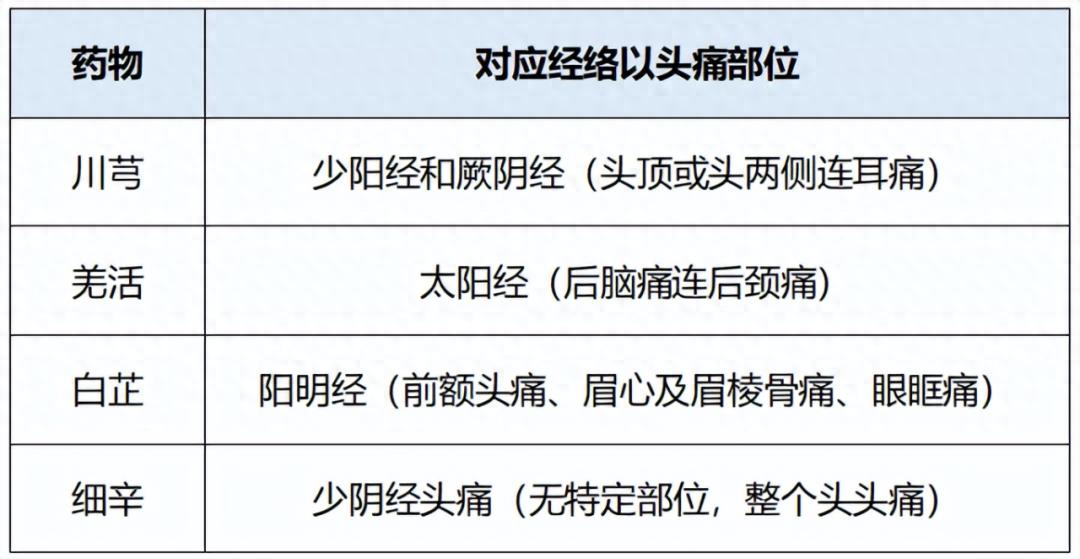
Chuanxiong Rhizome (Ligusticum chuanxiong): Activates blood circulation and moves qi, excels at dispelling wind and promoting blood flow to relieve headaches.
Peppermint (Mentha haplocalyx): Clears wind and dissipates heat, reduces swelling. Used in large quantities in the formula to counteract the warm and drying properties of the other herbs.
Schizonepeta (Schizonepeta tenuifolia): Light and ascending, adept at dispersing wind and relieving pain, and can also clear and benefit the head and eyes.
Notopterygium root and Angelica dahurica: Both can dispel wind and relieve pain.
Asarum: Asarum disperses cold and relieves pain.
Saposhnikovia root: Saposhnikovia root is pungent and dispersing, good at resolving wind pathogens in the upper body.
Honey-fried licorice: Boosts qi and harmonizes the middle, harmonizes all herbs.
Doctors remind that although Chuanxiong Chatiao San is effective for treating headaches, there are many causes of headaches, and it may not be suitable for all cases.
Chuanxiong Chatiao San has a generally warm medicinal nature, with strong dispersing and ascending effects, and is mainly used to treat headaches caused by external wind pathogens. It is not suitable for headaches caused by internal stirring of liver wind, hyperactivity of liver yang, phlegm syncope, upward attack of liver-gallbladder excess fire, or deficiency of qi and blood. Therefore, when experiencing headaches, it is important to seek medical consultation and follow the doctor's advice for medication.