Place a "treasure" under your child's pillow to keep rhinitis away! Dispel cold and open the orifices—perfect for use during the "Sanjiu" (Three-Nine) period.
We have now entered the "Sanjiu" period (the three nine-day periods following the Winter Solstice), which will continue until the 16th.
Sanjiu corresponds with Sanfu (the hottest days of summer) and represents the coldest time of the year. In the outpatient clinic, many children are seeing their rhinitis "report for duty" again. They start sneezing upon waking in the morning, deal with continuous watery rhinorrhea throughout the day, and suffer from nasal congestion as soon as they lie down at night, causing overall physical discomfort.
This is because during this period, Cold Evil (Han Xie) is dominant, which easily damages Yang Qi and invades the Lungs. Since "the Lungs open into the nose," the invasion of Cold Evil leads to a failure of Lung Qi to disperse (Xuan), resulting in blocked nasal passages and making rhinitis outbreaks highly likely.
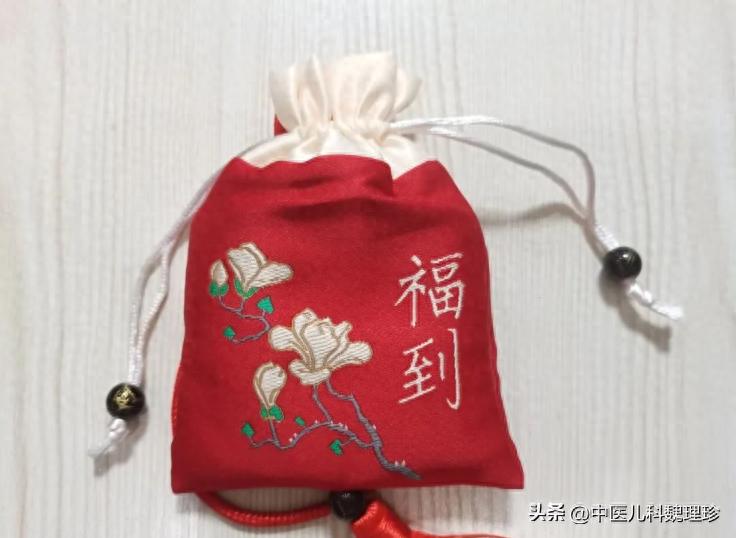
If the child's condition is not severe and they are resistant to taking medication, rather than using nasal sprays, it is better to make a traditional Chinese medicine (TCM) herbal sachet for the child to carry or place under their pillow at night. Herbal sachets utilize the pungent, dispersing, and mobile nature of aromatic medicinal materials to diffuse Lung Qi, dispel wind, and open the orifices, thereby clearing congested nasal passages and dissipating external pathogens.
Herbal Sachet Formulas for Different Types of Rhinitis
1. Cold-type Rhinitis
(Clear watery nasal discharge, pronounced aversion to cold)
Medicinal Composition: Flos Magnoliae (Xinyi) 6g, Radix Angelicae Dahuricae (Baizhi) 4g, Herba Asari (Xixin) 2g, Ramulus Cinnamomi (Guizhi) 3g, Fructus Xanthii (Cangerzi) 3g
Indications: Nasal congestion with clear discharge, symptoms worsening upon exposure to cold, pale complexion, pale tongue with a white coating.
2. Heat-type Rhinitis
(Thick yellow discharge, dry mouth, and red/inflamed throat)
Medicinal Composition: Menthae Haplocalycis Herba (Peppermint) 5g, Lonicerae Japonicae Flos (Honeysuckle) 4g, Chrysanthemi Flos (Chrysanthemum) 4g, Scutellariae Radix (Skullcap) 3g, Centipedae Herba (Small Centipeda Herb) 3g.
Indications: Thick yellow nasal discharge, dry and itchy nose, red and swollen throat, red tongue with a thin yellow coating
3. Spleen Deficiency Rhinitis
(Recurrent episodes, loss of appetite)
Medicinal Composition: Astragalus membranaceus (Huangqi) 5g, Atractylodes macrocephala (Baizhu) 4g, Saposhnikovia divaricata (Fangfeng) 3g, Amomum villosum (Sharen) 3g, Acorus tatarinowii (Shichangpu) 3g
Indications: Recurrent rhinitis, sallow complexion, poor appetite, loose stools, pale and puffy tongue with teeth marks
Directions for Use: Grind each medicinal ingredient into a coarse powder. Mix and place into a cotton bag (approximately 20g per bag). Position the bag under the child's pillow or at the head of the bed. Replace with a new bag every two weeks.
What should be done if the child has symptoms of a cough?
Dry cough with little sputum: Add 3g of Fritillaria cirrhosa (Chuan Bei Mu)
Profuse white sputum: Add 4g of Pericarpium Citri Reticulatae (Chen Pi)
Severe nocturnal cough: Add 3g of Schisandra chinensis (Wu Wei Zi)
However, for children with long-term rhinitis, it is best to provide symptomatic treatment and conditioning, which yields faster results and more lasting effects.
I previously treated a 5-year-old child who had suffered from rhinitis for two years. They had used many nasal sprays and Western medications, but the condition never fully resolved. The child's nasal mucosa had become more fragile than before, and their nose would run at the slightest provocation during winter.
Since the beginning of autumn, the child's rhinitis had been recurring persistently. It was only later, through a recommendation, that they decided to try Traditional Chinese Medicine (TCM) conditioning.
The child presented with typical allergic rhinitis, characterized by frequent morning sneezing, profuse clear nasal discharge, and severe nasal congestion. In addition to the rhinitis symptoms, the child also exhibited poor appetite, dark circles under the eyes (cyanosis infraorbital), a pale tongue, and a white tongue coating.
The syndrome differentiation for the child indicates deficiency of Lung and Spleen Qi, with cold pathogens invading the Lung.
Considering the child's young age and the difficulty they have consuming decoctions or granules, the traditional Chinese medicine was prepared as a herbal paste (Gao Fang). Maltose was added for flavoring, and it is packaged in small individual sachets that can be easily prepared by mixing with boiling water.
I also provided the child with a Chinese herbal sachet to carry at all times. After the first two weeks of treatment, the child's nasal discharge significantly decreased, and nasal congestion during sleep at night also improved.
Subsequently, the focus should be on regulating the child's physical constitution, as this is the fundamental way to prevent the recurrence of rhinitis.